Cutting-edge A.I. tools are helping Ops teams in the middle- and back-offices create software applications rather than wait for IT departments. This “vibe coding” can help Ops teams but has serious drawbacks that firms will need to address. At the same time, software engineers are exploring the benefits of A.I. tools.
Artificial intelligence tools are spreading fast across many facets of securities-trading operations, and an emerging trend in which end-users write applications—aka “vibe coding”—may soon capture the imagination of many Ops teams.
While software solutions — from small to large — created via vibe coding can be helpful within a group, they rarely scale to the enterprise level, can yield data detours that obscure potential problems from reconciliation systems, and could become rogue, major security threats to external systems.
The obvious antidote to these do-it-yourself (DIY) efforts would be configurable, well-governed, enterprise-wide-accessible, and quickly delivered software solutions that ease problems and create new paths for end-users. Such a scenario might emerge via a separate A.I. trend known as “agentic engineering,” and that would eliminate the incentive to launch ungoverned, potentially aggressive solutions.
The Vibe Is Frustration
To a large extent, the appeal of vibe coding is being driven by the frustration that Ops teams have toward software engineers, programmers, and IT departments that cannot quickly respond to software development requests because they are serving multiple constituencies within a firm.
Ops teams pointed to this frustration during a recent online FTF webinar, “Why Automation Alone Doesn’t Scale Operations,” on June 9 of this year. Participants were asked about IT support during a poll on automated processes. Nearly one out of four, or 24 percent, of respondents identified reliance on IT support as “an operational challenge” when they were asked, “What is the biggest challenge your firm faces in respect of operational processes which have been automated?”
So, it’s very tempting for Ops teams when the opportunity arises to develop solutions on their own via A.I. tools.

Kevin McPartland, head of research for market structure and technology at Crisil Coalition Greenwich
“For the uninitiated, vibe coding is the process of asking a GenAI assistant in plain language to build a program to do, well, whatever you want,” explains Kevin McPartland, head of research for market structure and technology at market research firm Crisil Coalition Greenwich. He delves into the subject in his blog post, “Vibe Coding is a Big Deal for Capital Markets.” For instance, end-users can use A.I. tools to retrieve stock prices from Yahoo! Finance, craft a market dashboard to track portfolios, or create a web-based dashboard to keep tabs on the schedules of children, McPartland says.
“The results from a single prompt can be mind-blowing,” he says. The AI tool “writes in a few seconds what would have taken hours, days, or weeks the old-fashioned way. I graduated with a computer science degree in 1999, so I’ve experienced this firsthand. Not to mention A.I.’s ability to fix bugs. A prompt as simple as ‘this isn’t working’ can be enough to fix programming errors that, again, might have taken hours or more to correct in days of yore.”
So, the demand for something like vibe coding is not new.
Jeff McGee, product and solutions manager at AutoRek, notes that within Ops teams there have always been people “trying to build these little side-of-desk tools that are outside of our normal ecosystem, whether it’s moving a file from A to B, or normalizing data quickly.” However, these desk tools “end up being things that are just undocumented, that are not version controlled.”

Jeff McGee, product and solutions manager at AutoRek
While the impromptu apps might be helpful, “if that person leaves, no one knows how to use it. They tend to also be very finicky, and you spend a lot of time just fixing these things, tweaking them, and just maintaining them,” McGee adds. It’s similar to when end-users created apps via Microsoft Visual Basic for Applications (VBA) coding or the programming language Python to create shortcuts and workarounds. “Now they’re just using another tool. I mean, you could say it’s a little better, a little easier,” McGee says.
But the potential downside is that while anybody can use A.I. tools, “they know enough to be dangerous,” McGee says. “A lot of times it’s your newer, younger employees that come in and start doing this stuff. They don’t necessarily understand the industry yet. They don’t understand the day-to-day, but they do know how to do some vibe coding. They know some Python; they know some VBA. They want to build little tools to show their value. They may have some baseline knowledge, but they don’t have enough knowledge to know how to build these platforms out to the extent that they need to be at an enterprise level. …. It’s not that there’s ever ill intent; it’s just they don’t know what they don’t know.”
Beyond Vibe Coding
Despite the media hype about vibe coding, Ops teams and managers should not confuse software developed via impulses with agentic engineering, which is software systems created with the help of A.I. tools but are still under the control of humans.

Colin Eberhardt, CTO at Scott Logic
“Vibe coding in its purest sense is where you build software applications using A.I., but you don’t look at the code at all. That’s the strictest definition of vibe coding,” explains Colin Eberhardt, chief technology officer (CTO) at Scott Logic, a bespoke software consultancy based in Newcastle upon Tyne in the U.K. Eberhardt is also a board member at the Fintech Open Source Foundation (FINOS), an umbrella organization of the Linux Foundation.
Eberhardt works with investment banks and other financial services firms and says that he is skeptical that vibe coding will become widely adopted at securities firms. Instead, the “agentic engineering” of software has taken off “in a big way” at securities firms, Eberhardt says.
“The majority of financial services organizations are now using tools like Claude Code, GitHub Copilot, and are trying to automate as much of the authoring of code as possible,” Eberhardt says. “However, it is still seen as an engineering discipline with engineers hands-on, engineers still understanding the output, and still understanding the code.”
To Ban Or Not to Ban
Given the drawbacks of vibe coding, firms are addressing the question of whether it should be banned or encouraged.
“I think a lot of this depends on the risk profile of the application itself. I am positive about the use of vibe coding to a certain extent for systems and applications that are low risk,” Eberhardt says. “If it’s something that helps enhance your personal productivity or maybe an internal-facing tool that helps you and your team, then potentially vibe coding is a viable way to develop that. However, if it’s something that is client-facing or something where there are regulatory requirements that inform how that piece of software should work, then you simply cannot vibe code that.”
For McGee, he says whether or not to ban vibe coding should be done on a case-by-case basis.
“There needs to be some sort of approval or vetting process. … As a former head of operations, finding out that something went wrong down the line, you have to investigate, and you start to find these tools that you did not know about,” he says. This becomes a major problem if vibe coding caused an issue that involves clients “that then want a root cause analysis of why X, Y, Z happened. It’s a little tough to explain to them that, ‘Well, there’s some function going on here that I was unaware of.’ ”
If vibe coding should survive and evolve, firms have to govern it. “So there needs to be some level of documentation and almost like a committee just to review what is in place,” McGee says. “Middle and back-office employees don’t like documenting processes.”
This leads to vibe-coded systems that exist only to help specific groups, not the entire enterprise. “A lot of times people say, ‘Oh, it only sits on their computer because they use it on their client set. Other people don’t use it.’ So, you don’t want to prohibit innovation and efficiencies and things like that, but you need to do it in the right way,” McGee adds.
Even a vibe-coding enthusiast like McPartland is urging caution and governance. “We must move forward carefully,” he says. “The story of vibe-coding transforming markets isn’t without its challenges. All of this new code must also be managed within big and small financial institutions. If you’re of a certain age, you remember when trading desks were fully run on spreadsheets that only a single trader understood. If they broke, were deleted, or the trader left, it was bad news.”
The industry sorted out “how to keep an eye on, and maintain an audit trail for, those spreadsheets,” McPartland notes. “Vibe-coded apps need the same thing. You should want your people to be innovative and creative and not slow them down. But as these apps get closer to clients and production systems, some oversight, whether it be cybersecurity or data quality, is a must. This is a challenge even the most sophisticated firms are still working to solve.”
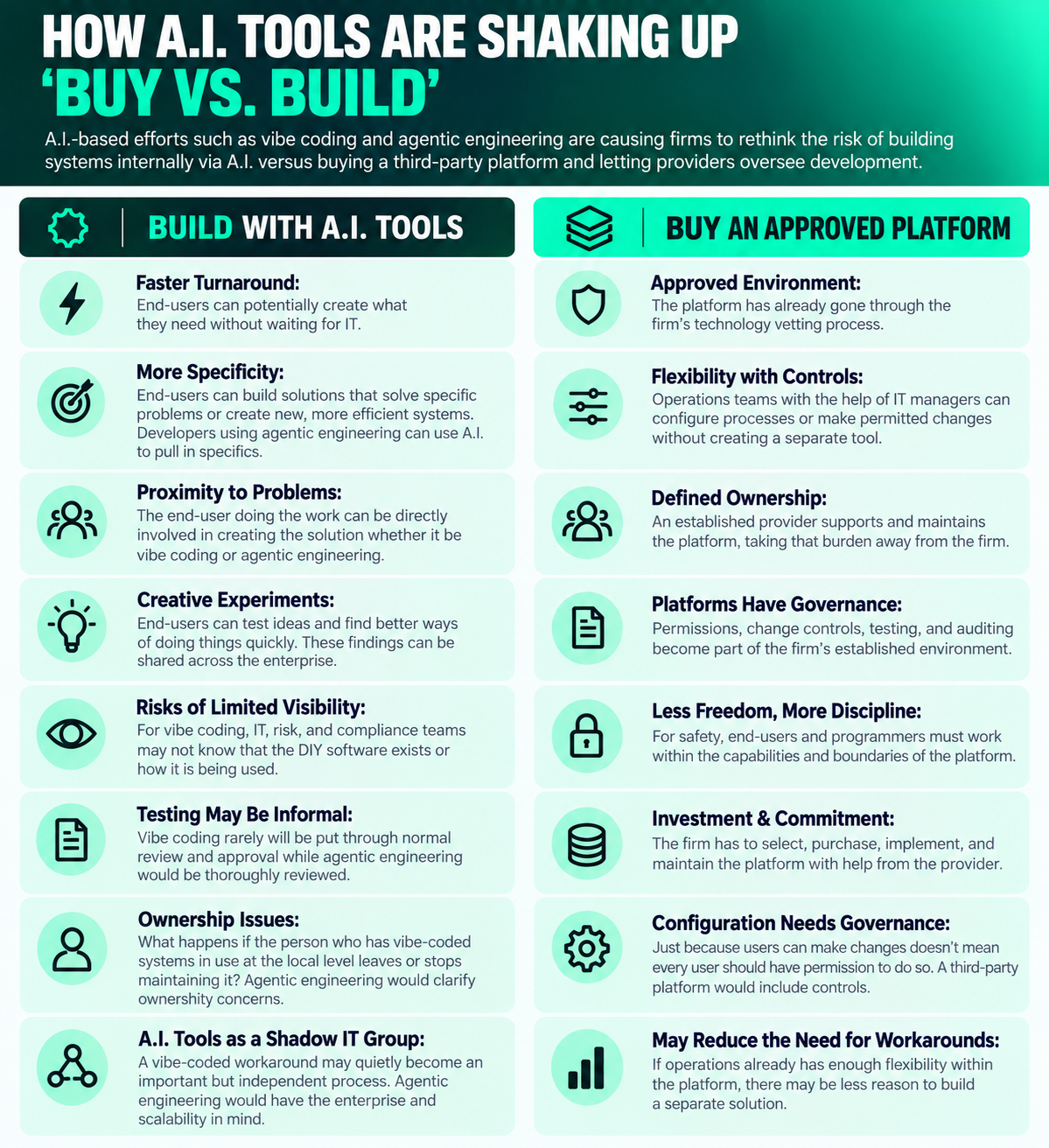
A New Twist on Buy vs. Build
While it’s early days for A.I.-based changes for Ops, the DIY aspects of vibe coding and agentic engineering will challenge the dynamics for the classic question of whether a firm should buy or internally build software applications.
Part of the problem is that end-users may only partially use the features and functions of a provider’s offerings, Eberhardt points out. “Take Salesforce, for example, most people on Salesforce only use a fraction of the functionality,” he says.
A.I. “will change the dynamics. And investment banks have a long history of erring toward building their own systems. I mean, some of them created their own programming languages. For example, Goldman Sachs created Slang [Securities LANGuage]. I mean, that’s pretty radical … if you’re going to invest in your own programming language. And the pendulum has swung the other way toward favoring buy, but I do think the pendulum will swing back again.”
Whether firms decide to internally develop A.I.-based systems or turn to a provider, they will need a new level of security to fight off attacks from A.I.-empowered platforms, Eberhardt says.
“As I’m sure you’re aware, the ability of these tools to attack software has increased significantly. And if I were in the position of buying a new platform at the moment, security would always be on my list. But I think security would have to be a much greater focus now. I’d want to ask an organization: ‘How rapidly can you roll out fixes?’ Because as an industry, I think there’s a tsunami coming of people exploiting and attacking systems. And while organizations need to do as much as they can to prevent an attack, I think we are moving to a period where attacks are going to be happening. And what’s more important is your ability to spot an attack and remediate,” Eberhardt says.
In addition to the new security concerns, firms will have to consider how vibe coding or some variation thereof could make reconciliation and exception management much more complicated.
“Depending on how you code, a lot of times people are trying to fix or normalize data before they put it into these reconciliation tools,” McGee says. “There’s a fine line between enhancing data so you’re actually comparing apples to apples versus covering up breaks in data … If somebody doesn’t necessarily know the boundaries of what needs to be done, they may be actually covering up or missing an aspect of the reconciliation that they’re just not pulling into their coding, and it just can mask actual true breaks for an indefinite period of time.”
McGee cites a real-life example from his time working in the securities industry. He knows of a firm that traded “a lot of swaps that would have had 15-, 20-year durations, and they just sat on your books the entire time,” he says. “After we started reconciling out a little bit more in depth, we found some breaks that were sitting there for seven years.”
This was because the key attribute of the maturity date was not being pulled into the firm’s data flow for reconciliation and exception management models. The Ops team dismissed the maturity date as “not an economic aspect,” McGee says. “I said, ‘Well, it is. It affects the accrual.’ The maturity date was off by a year, so it accrued at a different pace. And, at the end of it, it sat for seven years.”
The answer to that situation was a third-party platform that could pull in the maturity date and other important information.
“At the end of the day, you build out a more robust reconciliation platform by someone who knows what the true attributes are,” McGee says. “You need to look at the actual contract attributes and the underlying aspects of it to help you with more of the root cause analysis. It was always carrying a market value break, but they never really figured out why.”
The lesson is not lost on McGee — firms must find the data and, if necessary, fix it for whatever systems — A.I.-based or not— are downstream. “The reconciliation is only as good as the data you’re going to pull in. It can only validate what you pull in. And if you’re not going to pull it in because your downstream model never told it to, it’s not going to have the full view that you would want,” he cautions.
And getting the full view is one of the hallmarks of A.I.
Key Takeaways:
- Software systems created via vibe coding often cannot scale to the enterprise level, can yield data detours that obscure reconciliation and exception management woes, and could become rogue security threats to external systems.
- Ops teams will have to manage the new risks that come from potentially competing or redundant workflows established for the same process.
- Ops teams could be facilitating a shadow A.I.-based development effort that would be a haphazard way to make cutting-edge technology work for the entire enterprise.
- Firms may benefit from the speed and flexibility of employee-built tools that are attractive for solving problems but will struggle to make certain that the opaque, vibe-coded systems have the right controls around them.
- Firms will need strict governance and much stronger security controls in place if an employee-created productivity tool becomes part of the operational infrastructure.
- Firms that embrace employees experimenting with A.I. tools must set strong limits to prevent the explorations from crossing the line into destructive behavior.
Is your company featured in this article? Contact us about reprints or licensing.